

Elegant, Safe, and Durable Glass Balustrades
- Nov 10, 2025
- 6 min read
Updated: Jan 14
Choosing the right glass balustrade for your project
A glass balustrade gives you clear sightlines, a high-end finish, and modern edge protection without bulky posts. You see it on balconies, terraces, mezzanines, shopping centres, stadium boxes, and public walkways.
But not all glass balustrades are the same.
The right glass balustrade for a private balcony is not the right glass balustrade for a public terrace. The way the balustrade is fixed, the thickness of the glass, and the cost all change depending on how that space will be used and how much load the balustrade needs to safely resist.
If you’re pricing, specifying, or signing off a glass balustrade package, here’s what actually matters.
What is a glass balustrade doing, structurally?
A glass balustrade isn’t just there to look good. Its job is to act as a protective barrier. That means the balustrade has to safely handle people leaning against it, pushing on it, and in some cases, moving as a group against it.
That pressure is measured as a line load in kN/m (kiloNewtons per metre). The higher the required load, the stronger the glass balustrade system needs to be. Stronger systems mean heavier laminated glass, heavier base channels, bigger fixings, and more support in the slab or steel behind it.
This is why two “identical-looking” glass balustrades can be completely different in performance, compliance and cost.
Residential 0.74Kn
Shopping centers 3Kn
Public realm 1.5-3Kn
Sports stadium 1.5-3Kn
Typical load categories for glass balustrades
Different environments demand different performance levels from a glass balustrade. Below are the common categories and what they usually imply in terms of load, design expectation, and cost.
1. Private residential use (0.74Kn)
Example: a balcony on a single private home, or an internal landing within a dwelling.
In a true private residential setting, a glass balustrade is generally designed for lighter use: a couple of people leaning, not a crowd gathering. At this level, the system can use slimmer base shoes, lighter laminated glass, and more discreet fixings.
Why this matters:
You get that minimal, frameless-style glass balustrade look at the most cost-efficient point.
Installation time is shorter because the materials are quicker to make and lighter to handle.
You’re not overpaying for commercial-grade performance you’ll never need.
Where people go wrong:
Developers sometimes assume “residential spec” glass balustrades can also be used on shared roof terraces and communal podium decks. The moment a space is shared, it’s no longer a private residential condition. That changes the load requirement, and it changes the balustrade.
Cost impact:
If you priced your glass balustrade as private-use only and it later gets classed as shared access, you can see a significant cost increase because the entire specification steps up: thicker glass, heavier channel, higher-capacity fixings, and sometimes additional support.
View some of our residential projects here.

2. Communal terraces / public realm / shared amenity spaces (1.5-3Kn)
Example: shared roof terraces in an apartment block, communal podium balconies, accessible landscaped decks and public walkways.
Here, the assumption is simple: people will gather. Multiple people may lean on the same run of glass balustrade at the same time. You’re no longer designing for one person resting an elbow, you’re designing for groups leaning, pushing and moving.
What changes in the glass balustrade:
Thicker laminated glass panels
Stronger, deeper base channels
Heavier anchoring detail back into concrete or structural steel
Stricter control on deflection (how much movement is acceptable under load)
Project impact:
The heavier the glass balustrade system, the more planning is needed for lifting, handling, access and protection of finishes nearby. This isn’t “turn up with a couple of fitters and a van.” It requires high-level professional installation.
Commercial impact:
This is usually the point where value engineering either protects or destroys your margin. If you get this classification right at the design stage, you cost the correct glass balustrade system once, install it once and sign it off once. If you get it wrong, you’re delaying the project and ordering new materials at the end of the job.
An example of a balustrade like this can be seen in our work completed at One Canada Square in Canary Wharf.
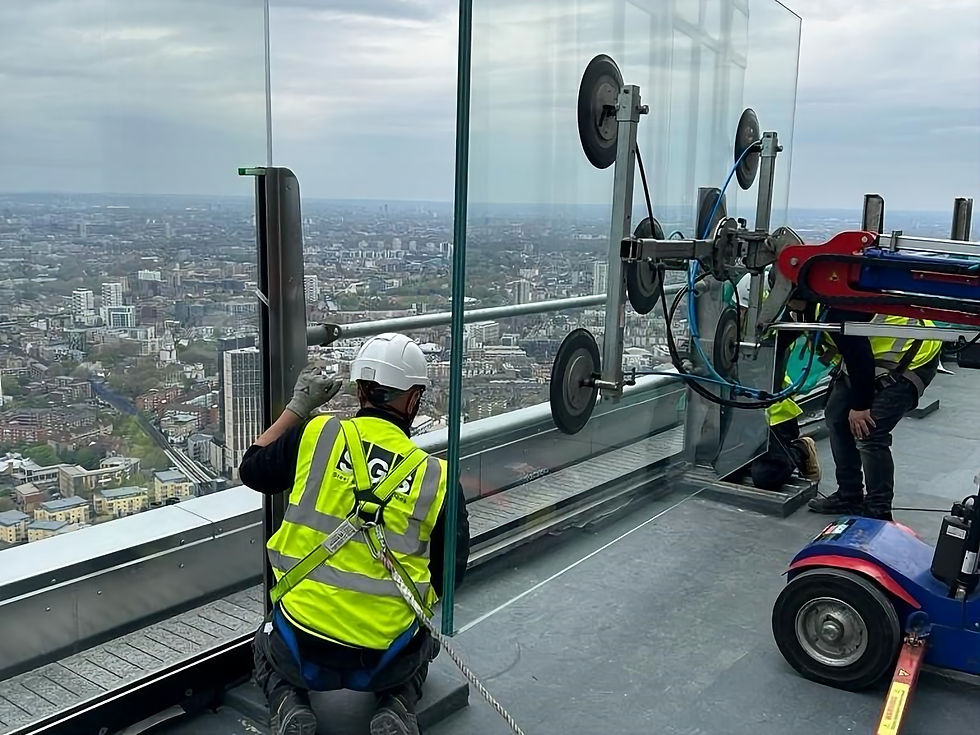
3. Shopping centres and high-footfall commercial areas (3Kn)
Example: balcony edges overlooking malls, retail mezzanines, viewing lines into open voids in a public circulation space.
These glass balustrades are expected to deal with constant occupation and crowd behaviour. For example, people leaning along the entire edge, staying there for long periods, gathering in clusters and resting their belongings.
What that means:
You are now into high-capacity glass balustrade systems.
The laminated glass is heavier again.
The base channel is usually a serious continuous shoe, mechanically fixed and designed to spread the load back into the structure.
You’re not just “protecting an edge”, the glass balustrade is part of crowd safety.
Cost and compliance:
This level of glass balustrade is more expensive for good reason. You’re paying for engineering assurance, certification, and full sign-off at handover. Landlords and Building Control will expect proof that the balustrade meets the correct load class and that deflection and containment are within tolerance.
This is also where “we’ll just swap the glass later if needed” is not realistic. If the balustrade isn’t designed to take this level of load from the start, you can’t just drop in thicker panels at the end. The fixing detail and the supporting structure need to be built for it.
4. Stadiums, rooftops, arenas, event venues (1.5-3Kn)
Example: hospitality boxes, upper-tier viewing edges, concourses.
In these environments, a glass balustrade must deal with more than leaning. It has to handle surges, groups of people moving and loading the barrier at once.
At this point:
The glass balustrade becomes safety-critical.
You may need an integrated or capping handrail that acts structurally, not just decoratively.
Fixing is typically back to primary steel or reinforced concrete, not a lightweight upstand.
This is the top end of performance.
Why load class affects the cost of a glass balustrade
Every time you move up a load class, you’re effectively buying a different product. Going from a private-use glass balustrade to a public-use glass balustrade can increase costs and it can jump again going from public-use to full crowd-capable.
That uplift is driven by:
Increased glass thickness and laminate build-up
Heavier base channel systems
Tighter fixing centres, heavier anchors, or secondary steel
More complex installation (more labour, more access planning)
Compliance paperwork for sign-off
So if you’re a contractor or QS and your prelims are already tight, you do not want to discover at handover that a supposedly “residential” terrace is actually classed as a shared public amenity and that every glass balustrade on it now needs upgrading.
That’s how you lose margin on what looked like a simple package.
The most common mistake with glass balustrades
“We’ll just design one glass balustrade detail and use it everywhere.”
Sounds efficient. In reality, it’s what creates cost shocks.
A single design rarely suits:
Private balconies on individual dwellings
Shared roof terraces
Public access decks
Retail mezzanine edges
Stadium hospitality fronts
Those are not the same environments, so they can not use the same glass balustrade spec.
Trying to force a “one size fits all” balustrade usually means one of two things happens:
You under-spec it and get blocked at sign-off, or
You over-spec everything to be safe and overspend in all the low-risk areas
Both are avoidable.
How SGS approaches a glass balustrade package
Steel & Glass Solutions designs, fabricates, and installs glass balustrade systems for residential, commercial, public and venue environments. Our approach is built around cost certainty and compliance.
Here’s how we keep control of both:
1. We classify each balustrade run by use, not by appearance
We don’t just ask “what does this glass balustrade look like?” We ask “who’s allowed to stand behind it, and how many of them at once?”
That defines the load class and stops you from accidentally applying a low-load residential balustrade spec to what is legally a public space.
2. We engineer the fixing strategy early
A high-performance glass balustrade is only as strong as what it’s fixed to. If your slab edge, parapet, or upstand won’t take the required load, we’ll tell you when you can still add steel, not when the scaffold is already booked to come down.
3. We price transparently by area and load class
You see exactly which glass balustrade lines are driving cost and why. That means you can protect margin in the low-risk areas instead of overpaying everywhere “just in case.”
4. We hand over with documentation
By completion, you’ve got the data you need to satisfy Building Control, landlords, centre management, warranty providers, and insurers. No last-minute scramble.
The bottom line on glass balustrades
A glass balustrade is not just an aesthetic decision. It’s a safety system tied directly to how that space will be used.
Private balconies and internal edges: lighter-duty glass balustrade, most cost-effective.
Shared terraces and public realm: higher-spec glass balustrade designed for groups leaning together.
Shopping centres and other high-footfall commercial spaces: heavy-duty glass balustrade with full crowd-resistance expectations.
Stadium and arena environments: glass balustrade as a crowd barrier, part of life-safety.
Get that classification right at design stage and you avoid redesign, delays, and margin loss.
Need a quote for a compliant glass balustrade package?
Send us your requirements and we’ll give you the correct glass balustrade specification, fixing detail, and price before it turns into a variation.


Comments